3iTT test
The following requirements apply to structural regeneration of coatings:
- not too fast in order to allow for good leveling,
- not too slow in order to prevent sagging and to ensure a sufficient wet-layer thickness.
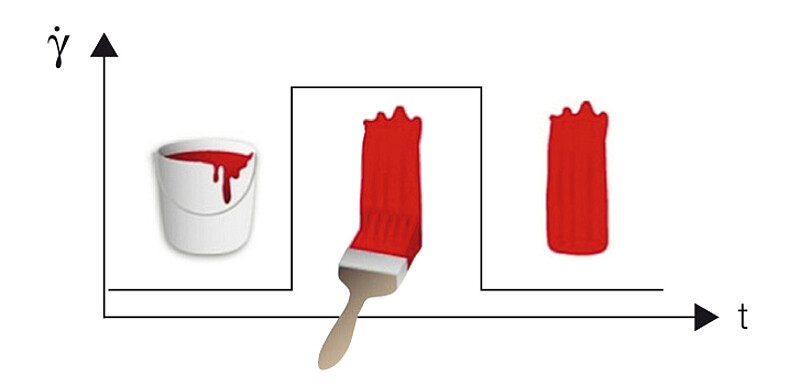
Thus, a compromise must be found between these two requirements. This compromise is balanced time-dependent behavior. To investigate time-dependent behavior, it is recommended that a step test be carried out, in this case as a rotational test with three intervals. This measurement is usually performed as a time-dependent controlled-shear-rate test (Figure 1):
- Interval (1) Very low shear to simulate behavior at rest at a preset low shear rate,
- Interval (2) Strong shear to simulate structural breakdown of the sample during the coating process at a preset high shear rate, for example when applying paint with a brush or by spraying,
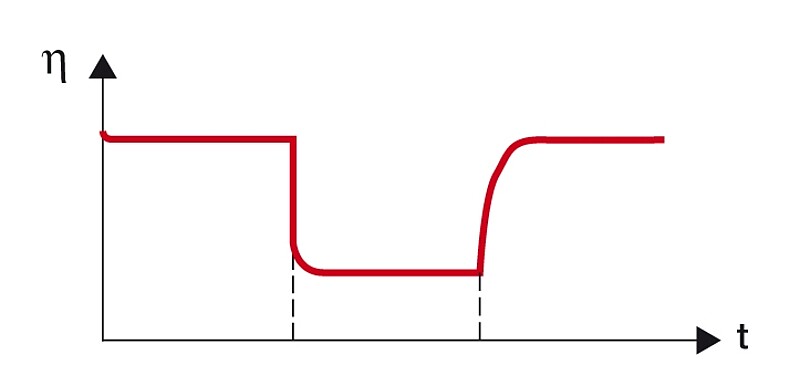
- Interval (3) Very low shear to simulate structural regeneration at rest after application using the same preset low shear rate as in the first interval. Usually, the result is presented as a time-dependent viscosity function (Figure 2):
- With viscosity values almost at rest,
- During structural breakdown under high shear conditions,
- During structural regeneration almost at rest.