Emulation Modes for Harmonized Particle-Size Analysis
Particle size and particle size distribution (PSD) are critical parameters that influence the performance, stability, and processing behavior of powders, suspensions, and emulsions across a wide range of industries, including pharmaceuticals, chemicals, food technology, and advanced materials. Among the most widely used techniques for PSD determination are laser diffraction and dynamic image analysis.
Laser diffraction (LD)
LD provides high-resolution size distributions based on light-scattering phenomena and is known for its robustness, speed, and broad dynamic range. DIA, in contrast, yields particle size and shape information directly from high-speed optical imaging, offering complementary insights into morphological features that cannot be captured through scattering-based measurement techniques.
Despite their extensive use, results obtained from different instruments – whether predecessor or competitor instruments – can show systematic deviations, even when based on the same measurement technique, arising from variations in optical models, hardware configurations, detection geometries, and data algorithms. These discrepancies make method transfer very complex, challenge continuity of long-term product specifications, and hinder the comparability of datasets generated across laboratories and manufacturing sites.
Systematic differences between instruments and measurement setups often lead to inconsistent results, making method transfer, long-term specification continuity, and cross-site data comparability highly challenging.
Dynamic image analysis (DIA)
Mechanical sieving is a standardized and widely used method for determining particle size distributions by separating a sample through a stack of sieves with defined mesh apertures and evaluating the mass fractions retained. Despite its robustness and low cost, the method is sensitive to sieve condition, and fine, cohesive, or irregularly shaped particles often result in limited accuracy and reproducibility.
DIA characterizes individual free-flowing particles by size and shape using high-resolution imaging, eliminating errors related to mechanical wear and extending the accessible size range. It can be configured to generate particle size distributions that are comparable with established techniques, such as sieving, and delivers improved reproducibility and faster analysis, offering practical advantages for routine laboratory use.
Emulation modes
As analytical technologies evolve, the need to align historical and contemporary datasets becomes increasingly important for maintaining process understanding, ensuring product quality, and meeting regulatory expectations.
To address these challenges, emulation modes have emerged as a promising strategy for improving cross-platform harmonization in particle-size analysis. Emulation allows a modern instrument to replicate the operational and computational characteristics of alternative or legacy systems, thereby enabling controlled comparison of measurement principles, facilitating method transfer, and reducing instrument-specific bias.
In LD, this involves reproducing scattering models, inversion parameters, and detector responses. In DIA, it requires alignment of imaging conditions, segmentation routines, and shape-descriptor calculations. By providing a reproducible framework for isolating and comparing analytical variables, emulation modes support both metrological rigor and practical usability in industrial and research settings.
This article discusses the principles, implementation, and benefits of emulation modes in laser diffraction and dynamic image analysis, focusing on their ability to improve data comparability, reproducibility, and traceability across different particle characterization methods.
Mechanical sieving is a robust and standardized sizing method. However, it has limitations in accuracy and reproducibility, especially for fine or irregular particles. DIA addresses many of these challenges while enabling comparability with established methods. As technologies advance, aligning historical and modern datasets becomes essential, making emulation modes a key strategy for harmonizing results across instruments and methods, and improving data comparability, reproducibility, and traceability.
Emulation modes for laser diffraction
Relativity of measurements
LD is fundamentally a relative measurement technique in which particle size distributions are inferred indirectly from the intensity pattern of scattered light using an assumed optical model, typically Mie theory or the Fraunhofer approximation. The resulting size distribution therefore depends on model parameters such as refractive index, absorption, and particle shape assumptions, as well as on the mathematical inversion used to convert scattering data into a volume-based PSD.
Consequently, while laser diffraction delivers robust and reproducible PSDs across a wide dynamic range, it remains model dependent. The complementary nature of LD highlights the importance of harmonization approaches, such as emulation modes, to improve comparability between fundamentally different analytical techniques.
When to use emulation
The decision to apply emulation modes in LD depends strongly on the analytical objective. Emulation is most appropriate when physically exact, model-independent results are not required and when all other measurement-optimization strategies – such as improving dispersion conditions or refining advanced instrument parameters – have been exhausted.
Under these circumstances, emulation provides a practical tool for aligning results with those obtained from a different instrument or method. This is particularly relevant in quality-control (QC) environments, for example, where long-standing specifications must be maintained across instrument generations or laboratory sites. QC users often prioritize keeping existing specifications and procedures over strict physical correctness.
Conversely, emulation should not be used when research-grade, physically accurate measurements are essential, as the imposed constraints of the emulated model may obscure true sample behavior. It is also unsuitable for analyses requiring highly sensitive outlier detection or in situations where a single, fully standardized method must be applied uniformly to all samples. In such cases, native measurement modes provide greater measurement reliability and clearer data interpretation than emulated modes.
How to use emulation
Two principal approaches are available for implementing emulation in particle-size analysis: Interpolated Mode and Translation Mode, each optimized for different types of reference information.
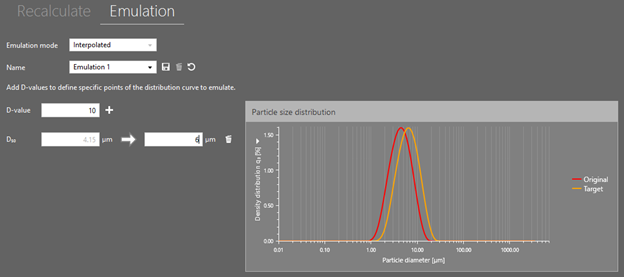
Interpolated Mode targets D-values and enables the particle-size distribution to be shifted horizontally or reshaped to match the general behavior of another instrument. This makes it especially useful when only limited information is available or when aligning results with different LD systems, such as instruments from a different supplier or predecessor instruments. Its relative simplicity also makes it easier to apply in routine workflows.
In contrast, Translation Mode targets the cumulative distribution and can yield a much closer match to the reference, owing to its use of fine size-bin resolution (shown in Figure 2). This makes it particularly effective when reproducing results from techniques such as sieving. However, successful application of Translation Mode requires access to the complete cumulative distribution, and its adjustments can be more complex and potentially unstable.
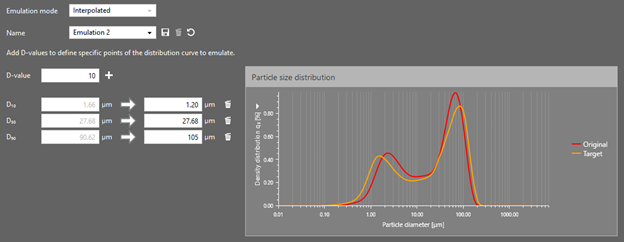
An effective optimization strategy therefore begins with selecting the mode that best corresponds to the available data: Interpolated Mode for sparse or D-value-only information, and Translation Mode when the full cumulative distribution is provided.
Regardless of the chosen mode, adjustments should be kept minimal, as modifying a single D-value is typically robust, whereas altering size-bin boundaries may introduce artifacts. Finally, all emulated results must be critically evaluated against the reference to ensure that no unrealistic peaks, distortions, or systematic shifts are introduced during the emulation process.
Table 1: Optimization strategy for laser diffraction emulation modes
| Interpolated Mode | Translation Mode |
| Limited information available / only D-values available | Cumulative distribution available |
| Changing single D-values: Usually safe | Changing size bins: More complex and unstable |
| Results should be compared with reference | Results should be checked for unrealistic peaks, distortions, or shifts |
Emulation mode for dynamic image analysis
Mechanical sieving is a standardized and widely established technique for the determination of particle size distributions. A representative sample is separated by passing it through a stack of sieves with defined mesh apertures. Mechanical agitation (shaking) promotes the classification of particles according to size, and the mass fraction retained on each sieve is used to derive the particle size distribution. Owing to its robustness, low cost, and long-standing acceptance, mechanical sieving is extensively employed for quality control in industries such as construction materials, food processing, and pharmaceuticals.
Despite its broad applicability, mechanical sieving exhibits several inherent limitations. The accuracy of the method is highly dependent on the condition of the sieve meshes. Wear, deformation, or clogging can alter the effective aperture size and introduce systematic measurement errors. In addition, fine, cohesive, or irregularly shaped particles often lead to poor reproducibility and increased variability in the results.
DIA, by contrast, characterizes free-flowing particles individually with respect to both size and shape using high-resolution imaging. This measurement technique avoids inaccuracies associated with mechanical wear and extends the accessible particle size range. It also requires a lower sample volume and provides more reproducible datasets with additional shape analysis. From a practical perspective, DIA offers substantial advantages, as measurements are significantly faster, leading to a considerable reduction in labor costs.
However, because mechanical sieving and DIA rely on fundamentally different filter functions, the resulting particle size distributions (density functions) may exhibit systematic shifts.
A particle is described by three orthogonal dimensions, as seen in Figure 3.
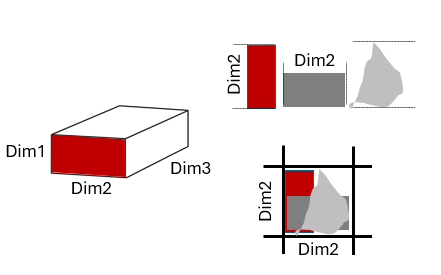
Dimension 1 (Dim1) represents the smallest extent of the particle, dimension 2 (Dim2) corresponds to the intermediate extent, and dimension 3 (Dim3) denotes the largest extent, typically referred to as the particle height. In mechanical sieving, particle separation is governed primarily by dimension 2, as this dimension determines whether a particle can pass through a sieve aperture. Dimensions 1 and 3 have a comparatively minor influence on the separation process, and dimension 3 does not affect the result.
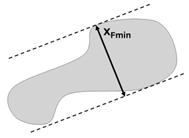
Consequently, any method aiming to emulate the behavior of mechanical sieving must accurately represent dimension 2. In DIA, particles are recorded as two-dimensional projections of their three-dimensional geometry on a sensor plane. As a result, a three-dimensional particle is characterized by its two-dimensional shadow image. From this projection, a single characteristic size parameter is extracted for the calculation of the particle size distribution (PSD). This parameter, known as xFmin (Figure 4), represents the smallest measurable dimension within the two-dimensional particle projection and is used as a surrogate for dimension 2.
However, as xFmin is not identical to dimension 2, using xFmin to imitate mechanical sieving introduces a systematic deviation. This deviation is negligible or even zero for regular particle shapes, such as spheres or cubes, where the particle dimensions are similar in all directions. However, for irregularly shaped particles, the discrepancy increases with increasing particle irregularity. In summary, increasing particle irregularity leads to increasing deviation.
To address this effect, a functional relationship between xFmin and dimension 2 is established. By modeling this relationship, dimension 2 can be emulated based on the measured xFmin values. Applying this model to DIA data allows the resulting particle size distributions to closely reproduce the separation behavior of mechanical sieving.
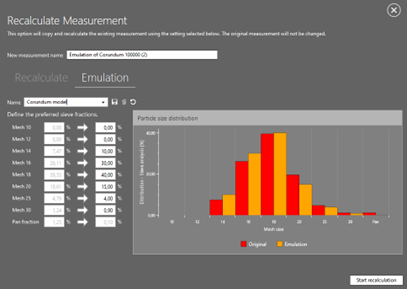
By using the sieving emulation mode, a particle size distribution based on sieve bins can be obtained. Depending on the irregularity of the particles, differences from the results of mechanical sieving will be shown. These differences can be used to calculate a sieve emulation model, which can then be applied to the measurements.
Summary
This article addresses the challenge of comparing particle size distributions obtained by different measurement techniques or instruments with laser diffraction and dynamic image analysis. Modern optical techniques such as laser diffraction and dynamic image analysis provide faster, more precise, and more comprehensive particle characterization. However, due to fundamentally different measurement principles and size definitions, their results are not directly comparable to data obtained from other instruments or sieve-based data. For this purpose, the emulation modes of the Litesizer DIF and Litesizer DIA series provide an effective tool for improving the comparability of measurement datasets with established reference data, while fully preserving the methodological advantages of laser diffraction and dynamic image analysis.