Injectability
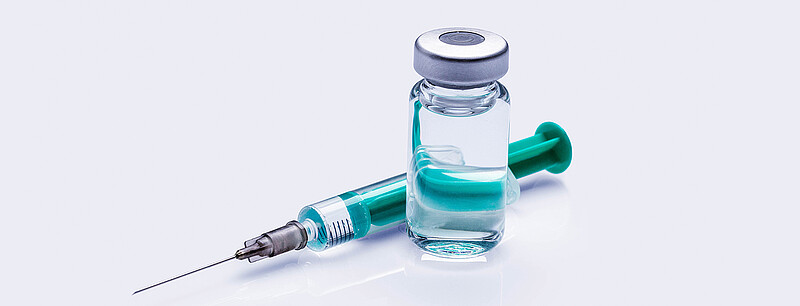
When it comes to injecting a vaccine, comfort is key. The viscosity of the injectable has a great impact on perceived injection pain. Low-viscosity injections are perceived to be more painful than higher-viscosity injections. However, too-high viscosity can lead to an injection system occlusion, which makes completing the injection difficult and is therefore a risk for patients. In addition, viscosity affects the injection time and the choice of the needle diameter. To avoid degradation and aggregation upon injection, high forces, occurring when vaccine formulations are pushed through narrow apertures in the syringe and small-bore needles, need to be accurately measured and controlled. Analyze the flow behavior of the sample and use it to optimize the viscosity to ensure proper injection, and measure how the shear forces during an injection affect the flow properties and the overall stability of vaccine formulations. With our portfolio of measuring instruments, you can analyze and optimize these parameters to ensure proper vaccine development and quality control.
Learn more about our solutions for injectability below.
Viscosity checks of the sample to ensure injectability/administrability

Challenge
The viscosity of the injectable has a significant impact on perceived injection pain. Low viscosity injections of 1 mPa*s are perceived to be more painful than higher viscosity injections of 15-20 mPa*s. However, a too-high viscosity can lead to an injection system occlusion, which makes completing the injection difficult and is therefore a risk for patients. Viscosity also affects the injection time and the choice of the needle diameter.
Furthermore, the volume of the drug can be decreased with a more viscous solution.
Solution
Measure viscosity at multiple shear rates/speeds with ViscoQC 300 or LOVIS 2000 M/ME, depending on analysis needs. Analyze the flow behavior of the sample and use it to optimize the viscosity to ensure proper injection.
Benefits
Obtain data to ensure a safe and painless injection for the patient.
For the measurement with ViscoQC 300, digital leveling eliminates incorrect results thanks to fully automatic level checking. Automatic spindle and guard detection ensure correct viscosity calculation. LOVIS 2000 M or ME provide short measurement times and low sample volumes of only 1 mL for your precious samples.
With all instruments, the software conforms to 21 CFR Part 11 regulations. Especially with V-Comply for the ViscoQC 300, the pharma qualification documentation is already included.
Additional information
Instruments:
- Rotational viscometer: ViscoQC 300 (optional V-Curve and V-Comply)
- Rolling-ball viscometer: Lovis 2000 M/ME
Check the pH value of your vaccine to control a risk factor for phlebitis

Challenge
Vaccine injections can cause phlebitis. The pH value of the substances involved and the final vaccine are a key risk factor for this. Measuring this value alongside other generally measured quality control parameters (e.g., density) must be easy.
Solution
Measure density, viscosity, and pH simultaneously in a modular set-up to check and control key product parameters – especially with regard to setting a suitable pH to reduce the likelihood of phlebitis occurring.
Benefits
Instrument modularity and fast measurements save time and costs compared to individually operated instruments, while providing all advanced technological and software features of the individual instruments and modules. The pH ME module is an easy-to-connect extension for an Anton Paar density meter or Lovis 2000 viscometer.
Key benefits are the additionally possible automatic calculation of all relevant parameters and the integration of necessary measurement data into one single data set. The small sample consumption (13 mL) and single filling of the system are additional advantages.
Additional information
Instruments:
- Benchtop density meter: DMA + Rolling-ball viscometer: Lovis 2000 ME + pH measuring module: pH 3101 / pH 3201
How shear forces affect vaccine stability

Challenge
During the injection of a vaccine into a patient, there are surprisingly high forces that occur because the vaccine formulation is forced through narrow apertures in the syringe as well as through a small-bore needle. These forces, if not measured and controlled, can cause degradation or aggregation of the active agent in the vaccine formulation. If a vaccine degrades or aggregates upon injection, the patient may receive a sub-therapeutic dose, or the aggregated particles may cause an immunogenic response.
Solution
A Modular Compact Rheometer (MCR) from Anton Paar directly measures how the shear forces that occur during an injection affect the structural and flow properties as well as the overall stability of vaccine formulations.
Benefits
Accurately characterizing how a vaccine formulation responds to the shear stresses that occur during injections helps detect and avoid injection-induced aggregation or degradation of the formulation. This ensures a safe and complete dose for each patient.
Additional information
Instruments:
- Modular Compact Rheometer: MCR 102e/302e/502e
Source:
- Dissecting the molecular basis of high viscosity of monospecific and bispecific IgG antibodies
Cholpon Tilegenova, Saeed Izadi, Jianping Yin, Christine S. Huang, Jiansheng Wu, Diego Ellerman, Sarah G. Hymowitz, Benjamin Walters, Cleo Salisbury & Paul J. Carter (2020) mAbs, 12:1, 1692764, DOI: 10.1080/19420862.2019.1692764 - Development of syringes and vials for delivery of biologics: current challenges and innovative solutions
Saki Yoneda, Tetsuo Torisu & Susumu Uchiyama (2021), Expert Opinion on Drug Delivery, 18:4, 459-470, DOI: 10.1080/17425247.2021.1853699
Application report: