The stability of cosmetics is a central challenge in formulation. Whether developing a pigmented suspension, a transparent serum, or a complex emulsion, formulators must ensure that products remain homogeneous, effective, and visually appealing throughout their shelf life. Instability phenomena such as sedimentation, creaming, flocculation, or phase separation not only affect product performance but also consumer perception and regulatory compliance.
One powerful but often underutilized tool for cosmetics stability testing workflows is zeta potential, including surface zeta potential. This electrokinetic parameter provides insight into the electrical charge at the surfaces of dispersed particles or droplets and in the surrounding interfacial layer. By quantifying particle–particle, droplet–droplet, and formulation–surface interactions, zeta potential and surface zeta potential offer a robust, quantitative way to assess and optimize formulation stability as well as interactions with target substrates such as skin, hair, or nails. This is particularly relevant in systems where electrostatic forces influence aggregation, deposition, adhesion, spreading behavior, and overall sensory performance.
Regulatory compliance
Stability testing of cosmetics is a fundamental requirement in the development of cosmetic products, ensuring that safety, quality, and performance are maintained throughout the product’s intended shelf life. From a regulatory perspective, legislation does not prescribe a single standardized cosmetics stability testing protocol but instead places the responsibility on manufacturers to demonstrate product stability under reasonably foreseeable conditions of storage and use. In the European Union, Regulation (EC) No 1223/2009 requires that stability data support the determination of the minimum durability date or the period after opening (PAO), and that this information be included in the Product Information File (PIF). Similar principles apply in other regulatory frameworks, such as the U.S. Food and Drug Administration (FDA) guidance and ISO standards (e.g., ISO 22716 and ISO/TR 18811), which emphasize a risk-based approach tailored to the formulation, packaging, and intended use of the cosmetic product. Consequently, stability testing strategies typically combine real-time and accelerated stability testing, along with physical, chemical, and microbiological assessments, to generate robust evidence of product stability in compliance with regulatory expectations.
Why zeta potential matters in cosmetic formulations
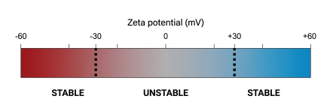
Most cosmetic products are dispersed systems, such as creams and lotions, serums with suspended actives, sunscreens with dispersed mineral particles, or nano- and microemulsions. For cosmetics stability testing, zeta potential provides information not only on the long-term stability of cosmetic products, but also on the ingredient matrix and surface interactions occurring within and around the formulation. If the zeta potential is high, particles strongly repel each other; if the zeta potential is low, the repulsion is weak, and particles tend to aggregate, flocculate, or coalesce (Figure 1).
Figure 1: Relationship between zeta potential values and colloidal stability in cosmetic formulations. Stable dispersions often require high negative or positive zeta potentials (>|30| mV) and become unstable near zero due to reduced electrostatic repulsion.
Emulsions
In emulsified systems, dispersed droplets acquire an interfacial charge as a result of the adsorption and orientation of ionic or ionizable emulsifiers at the oil–water interface. The resulting electrostatic potential at the shear plane (zeta potential) is a key parameter governing interparticle interactions within the dispersion.
Zeta potential provides insight into the resistance of droplets to coalescence, their sensitivity to changes in electrolyte concentration, and their compatibility with charged or surface-active actives and preservatives. A sufficiently high absolute zeta potential promotes electrostatic repulsion between droplets, thereby contributing to colloidal stability.
The addition of electrolytes or ionizable active ingredients can compress the electrical double layer surrounding the droplets, reducing the magnitude of the zeta potential. This compression weakens electrostatic repulsion, which may increase flocculation or coalescence risk and ultimately compromise emulsion stability.
Accordingly, zeta potential measurements are commonly employed in cosmetics stability testing during formulation development to optimize emulsifier selection, surfactant concentration, pH value, and ionic strength to achieve robust and reproducible emulsion stability.
Suspensions
In particulate cosmetic systems such as liquid foundations, mineral sunscreens, clay masks, and anti-dandruff shampoos containing zinc-based actives, product performance and sensory properties strongly depend on the stability of the dispersed solid phase. These formulations often represent highly concentrated, multiphase colloidal systems in which pigments, mineral fillers, or UV filters are suspended within a continuous phase. Particle aggregation can lead to undesirable effects, including increased grittiness, enhanced sedimentation rates, reduced homogeneity, and compromised aesthetic appearance. In mineral sunscreens, aggregation of TiO₂ or ZnO particles may additionally reduce effective surface coverage, potentially diminishing SPF (sun protection factor) performance and the uniformity of UV protection. Similarly, in foundation formulations, insufficient stabilization of pigments can impair color consistency, optical performance, and overall product quality.
Zeta potential is a critical parameter for cosmetics stability testing in particulate systems, supporting the assessment and control of colloidal stability. Quantifying the electrostatic repulsion between dispersed particles enables a deeper understanding of particle-particle interactions and supports the rational selection and optimization of dispersants, stabilizing agents, and other additives.
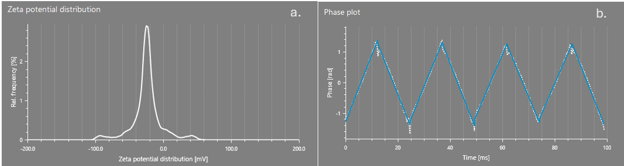
In an investigated foundation sample, the measured zeta potential was approximately –25 mV, indicating a moderately high magnitude of surface charge and suggesting that the system is within a stable electrostatic range. Appropriate adjustment and maintenance of zeta potential contribute to improved long-term stability, minimized settling and caking, and consistent functional and sensory performance throughout the product’s shelf life.
To further illustrate the electrokinetic characteristics of the formulation, Figure 2 presents the zeta potential distribution (a.) and corresponding phase plot (b.) of a representative foundation sample, highlighting the charge distribution of dispersed particles and the overall homogeneity of the system.
Figure 2: Zeta potential distribution (a.) and phase plot (b.) of a foundation sample.
Zeta potential, including surface zeta potential, is a valuable complementary tool for cosmetic formulation, providing early insight into the stability of suspensions, serums, and emulsions. Used alongside particle size analysis, rheology, and aging studies, it helps formulators better understand particle–surface interactions, identify stability risks sooner, reduce reformulation efforts, and develop more reliable, high-quality products.
Factors influencing zeta potential in cosmetics
pH value and skin compatibility
In cosmetics stability testing, pH is a critical parameter, influencing skin compatibility, ingredient stability, preservative effectiveness, viscosity, and the performance of active ingredients and polymers. Most cosmetic products fall within an overall acceptable pH range of approximately 4.0 to 8.0, with more specific targets depending on application type. Leave-on skin products are ideally formulated at pH 4.5 to 5.5 pH to match the skin’s natural acidity, while creams, lotions, and serums typically perform best between pH 5.0 and 6.5. Rinse-off products such as shampoos and body washes can tolerate higher values, commonly ranging from pH 6.0 to 7.5. Deviations from the optimal pH can negatively affect product quality and safety: overly acidic formulations may irritate the skin and destabilize polymers or surfactants, whereas excessively alkaline conditions can impair the skin barrier, reduce preservative efficacy, and trigger undesirable color or odor changes. As many thickeners, emulsifiers, and active ingredients exhibit narrow pH stability windows, precise pH control is essential for robust and effective formulations.
Ionic strength and electrolyte effects
Ionic strength also plays a key role in cosmetics stability testing by governing electrostatic interactions among polymers, surfactants, emulsions, and dispersed systems. In most cosmetics products, low to moderate electrolyte levels are preferred, typically corresponding to salt concentrations below approximately 0.1 wt % to 0.5 wt % for common electrolytes such as sodium chloride or magnesium sulfate. Elevated ionic strength can adversely affect formulation stability, leading to the collapse or precipitation of charged polymers, a reduction in viscosity in carbomer-based gels, and the destabilization of emulsions. Conversely, certain formulation systems – particularly salt-thickened surfactant-based products – rely on carefully controlled electrolyte addition to achieve optimal rheological and performance properties.
Surfactant selection and concentration
Surfactants are essential functional components in cosmetics formulations, enabling cleansing, emulsification, solubilization, and foaming while also exerting a strong influence on skin mildness and overall formulation robustness. Typical use levels vary by application: leave-on products generally contain low surfactant concentrations (≤ 1 wt % to 2 wt %), primarily as emulsifiers or solubilizers, whereas rinse-off products rely on substantially higher levels, commonly 5 wt % to 20 wt % based on total active surfactant matter. The selection of surfactants has far-reaching formulation implications, affecting pH tolerance, electrolyte sensitivity, and compatibility with polymers and preservatives. Milder surfactant systems, such as non-ionic and amphoteric types, offer greater formulation flexibility, while harsher surfactants tend to narrow the acceptable pH and salt ranges, increasing the risk of instability or skin irritation.
Polymer stability and formulation complexity
Polymers influence the rheology, texture, stability, and sensory attributes of cosmetic formulations. Each polymer exhibits a characteristic pH stability range (e.g., carbomer-based systems typically perform optimally between pH 5 and 8) and may be sensitive to multiple formulation variables, including ionic strength, surfactant type, shear conditions, and temperature. When polymers are used outside their optimal conditions, inappropriate pH or electrolyte levels can result in viscosity loss or phase separation. While polymer combinations can be employed to broaden the usable formulation window and enhance performance, they also increase formulation complexity. In general, natural polymers tend to exhibit narrower stability and tolerance ranges compared to their synthetic counterparts.
As an example, polymer–silicone hybrids in thermal‑protective hair formulations act by forming a cohesive, low‑permeability film that moderates heat transfer to the keratin fiber and stabilizes surface moisture during high‑temperature exposure. Polymers and copolymers provide structural integrity and controlled film formation, while silicones enhance thermal stability, reduce friction, and improve the uniformity of heat distribution across the cuticle. Their interaction with the hair surface can be quantitatively characterized through zeta‑potential distribution, which reflects changes in surface charge induced by polymer–silicone adsorption. Using dynamic streaming potential measurements, the persistent attachment of these conditioning films to the negatively charged hair substrate can be demonstrated, confirming both the affinity of the formulation components and the robustness of the protective layer under shear and fluid flow conditions.
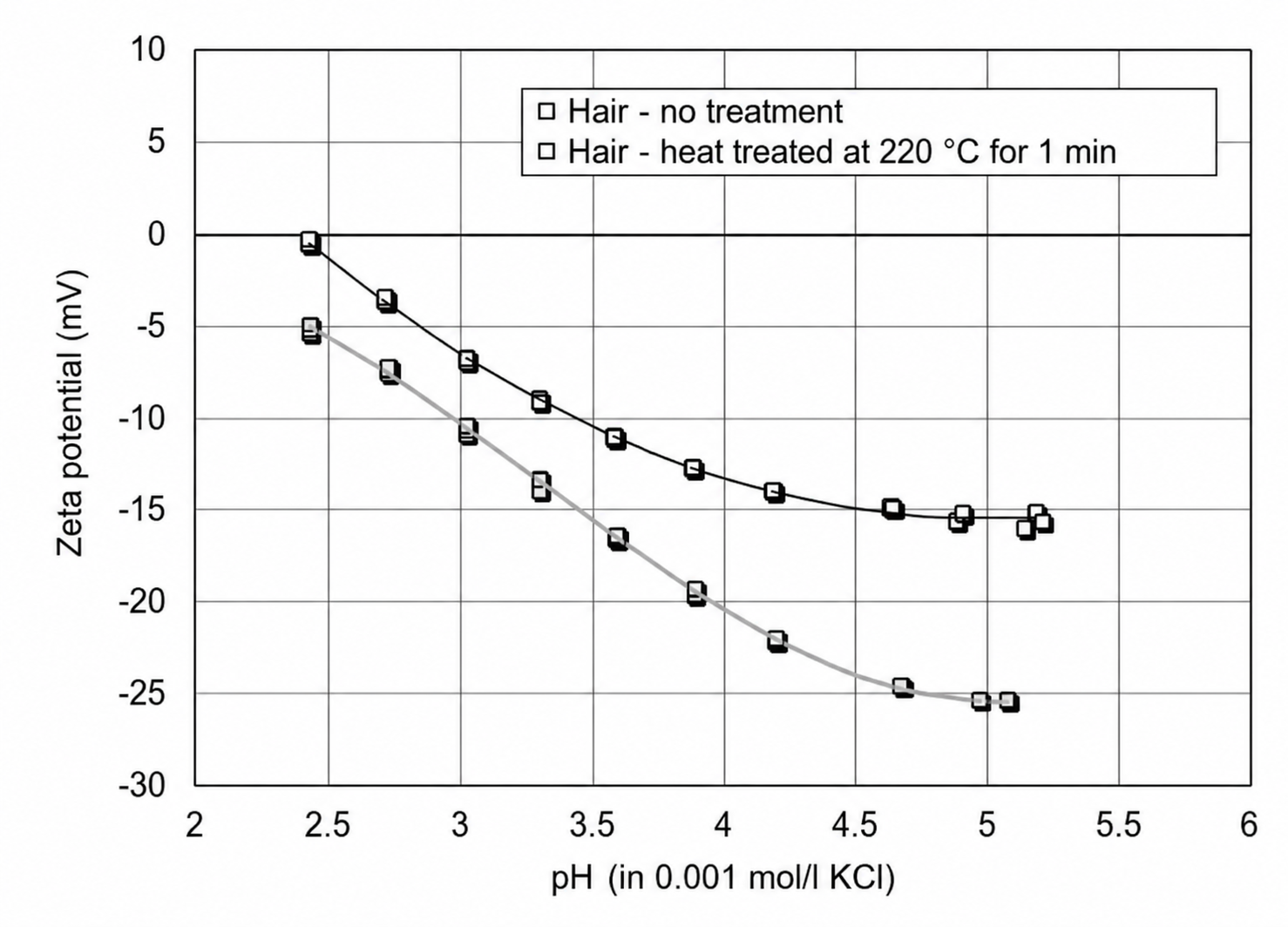
Figure 3: Zeta potential of human hair as a function of pH for untreated hair and hair heat-treated at 220 °C for 1 min on a hot plate. The short heat exposure causes irreversible changes in the hair surface chemistry, resulting in a shift towards more negative zeta potential values and a lower isoelectric point.
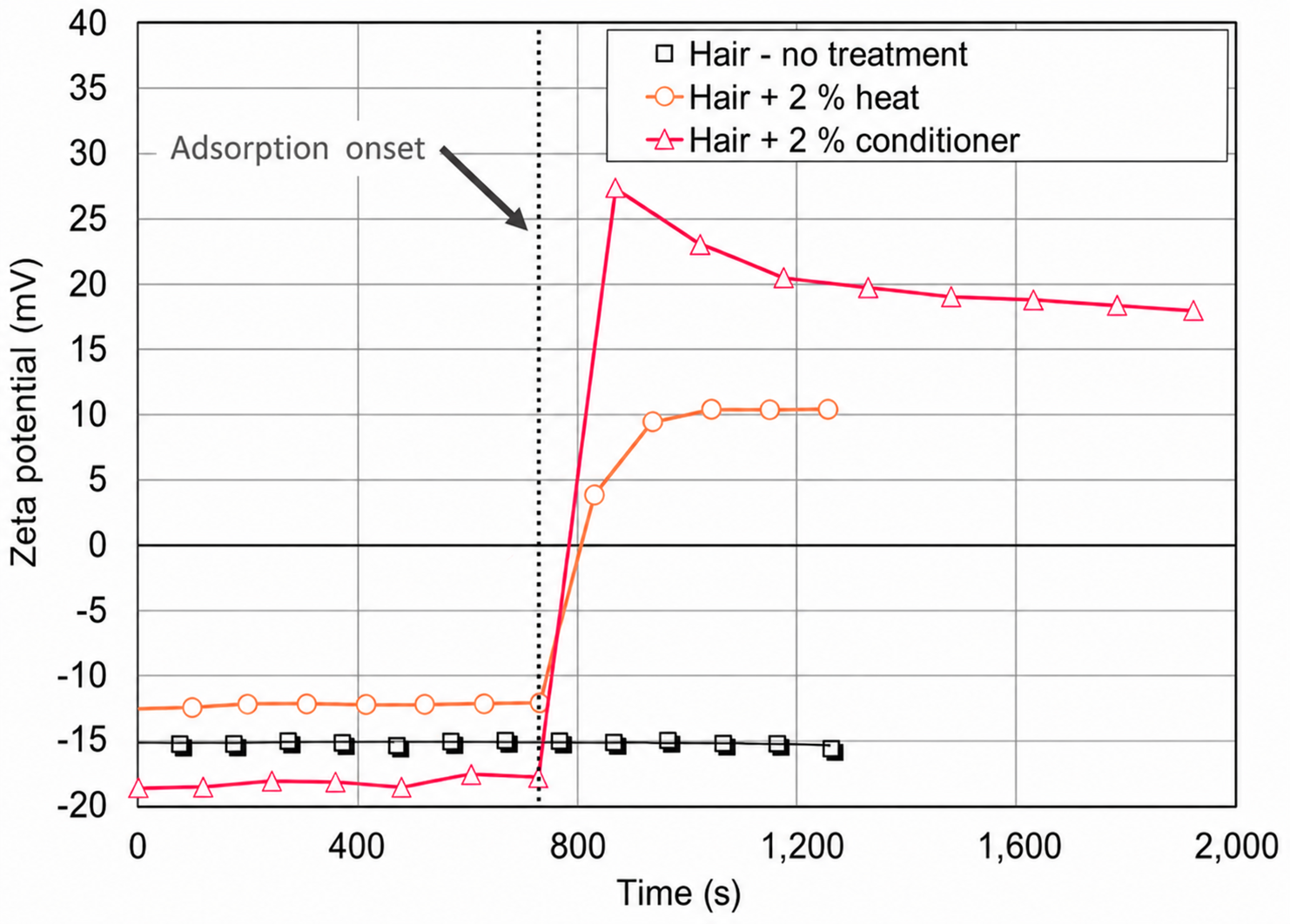
Figure 4 illustrates the adsorption behavior of two hair care products on human hair, as reflected by changes in surface zeta potential. A distinct shift in zeta potential values is observed following product application (orange and red curves) compared to the untreated hair sample (black curve). This indicates that the hair surface charge was modified due to the adsorption of formulation components.
Figure 4: Adsorption kinetics of pristine hair (black curve) after application of 2 % heat protection spray (orange curve) and hair that was treated with 2 % conditioner (red curve).
Zeta potential in cosmetic formulations is strongly influenced by pH, ionic strength, surfactants, and polymers, all of which govern electrostatic interactions and system stability. Precise pH control is essential, as deviations can compromise ingredient stability, preservative efficacy, skin compatibility, and polymer performance. Ionic strength and surfactant selection further affect charge screening, viscosity, and emulsion stability, with excessive electrolyte levels or harsh surfactants increasing the risk of instability. Polymers are particularly sensitive to pH and salt conditions, making careful optimization of all formulation parameters critical to ensure robust, stable, and high-performing products.
Influence of surface zeta potential on skin-cosmetic interaction
The interaction between cosmetic formulations and the skin surface is strongly influenced by surface charge properties, particularly surface zeta potential and the zeta potential of dispersed particles or droplets. Human skin exhibits a slightly negative surface zeta potential at physiological pH, primarily due to the presence of ionized carboxyl and phosphate groups in proteins and lipids of the stratum corneum. Consequently, the electrostatic characteristics of cosmetic ingredients, such as emulsified droplets, polymeric conditioners, pigments, or encapsulated actives, play a decisive role in their adhesion, deposition, and distribution on the skin. Particles or droplets with a positive zeta potential may exhibit enhanced electrostatic attraction to the negatively charged skin surface, potentially improving substantivity and targeted delivery. Conversely, similarly charged systems may experience electrostatic repulsion, reducing deposition efficiency. Therefore, understanding and controlling zeta potential enables formulators to modulate skin interaction, optimize performance attributes such as coverage and long-lasting effects, and design delivery systems with tailored deposition and release profiles.
Zeta potential as a complementary stability tool
It is important to note that zeta potential does not replace classical stability testing. Instead, it complements established approaches used to assess the stability of cosmetics, including particle size analysis, rheology, and accelerated stability testing of cosmetics. These methods align with widely recognized cosmetic stability testing guidelines, ensuring that the stability testing of cosmetic products is both comprehensive and reliable. Together, these techniques provide a more complete picture of formulation behavior, from early‑stage screening to final product validation.
Conclusion
Zeta potential offers cosmetic scientists a quantitative, sensitive, and efficient way to understand and improve the stability of suspensions, serums, and emulsions. By revealing the electrostatic interactions that govern aggregation and phase separation, it helps formulators make informed decisions early in development, reduce reformulation cycles, and design more robust products.
As cosmetic formulations become increasingly complex and performance-driven, electrokinetic measurements such as zeta potential are becoming an essential part of the modern formulation toolbox.
We use cookies on our website. Some of them are necessary (e.g. for the shopping cart), others help us make our online content better and easier for you over the long term via analysis, external media, and marketing services. We also use third-party cookies from providers in the USA like Google or Facebook if provided with your consent (Art. 49(1)(a) GDPR). Your data may be transferred to the USA which does not have a data protection level comparable to GDPR. In this case your data may potentially be accessed by US Authorities for surveillance purposes and you may not be able to exercise effective legal remedies. You can accept or reject all cookies by clicking on the respective button or define your cookie settings using the link "Customize your cookie settings".
If you reject all cookies, only technically required cookies will be used. You can also withdraw your consent at a later time by accessing the Cookie Settings.
Marketing cookies are used by third parties or publishers to show you personalized advertising. They do this by tracking which websites visitors go to.
Content from video platforms and social media platforms is blocked by default. If you accept cookies from external media, accessing these contents no longer requires giving manual consent.
After being informed of potential risks for my data (including transfer to the USA and potential access by US authorities) in the Cookie Banner and Privacy Policy I accept the cookies from US-providers.