ASTM D4440: Dynamic Mechanical Properties and Melt Rheology of Plastics
Introduction
ASTM D4440 is an international technical standard published by ASTM International which describes a methodology for determining and reporting the dynamic mechanical (viscoelastic) properties of molten polymers. The standard focuses on oscillatory shear rheology rather than rotational measurements and provides procedures for measuring quantities such as complex viscosity and dynamic moduli. These parameters are fundamental to the characterization of thermoplastic materials and are widely used in polymer science, materials engineering, and industrial processing.
Scope and methodology
ASTM D4440 is closely related in scope to ISO 6721-10. It is widely used in research and quality control, as well as for optimizing processing conditions for molten polymers. The standard specifies a test method in which a molten polymer sample is subjected to forced, non-resonant oscillatory deformation. In this context, “forced” refers to the fact that the deformation is actively imposed by the measuring instrument (typically a rotational rheometer), rather than arising from the natural dynamics of the material. The applied deformation is usually sinusoidal and controlled either in strain or stress.
The term “non-resonant” indicates that the measurement is performed away from the natural frequencies of the instrument–sample system. This ensures that the measured response reflects intrinsic material properties rather than inertial or mechanical effects associated with resonances. As a result, the method isolates the viscoelastic response of the polymer melt under well-defined conditions.
The method is a sensitive means of obtaining information on the mechanical response of the molten polymer over a wide range of frequencies (typically 0.01 Hz to 100 Hz) or time and strain amplitudes. It can be performed under isothermal conditions (constant temperature) or during temperature ramps, enabling the study of thermo-rheological behavior.
Rheological framework
The rheological characterization described in ASTM D4440 is grounded in the linear viscoelastic theory. Under oscillatory shear, the applied strain can be expressed as:
$\gamma(t) = \gamma_0 \sin(\omega t)$
and the resulting stress response is:
$\sigma(t) = \sigma_0 \sin(\omega t + \delta)$
where is the phase angle between stress and strain. From this phase relationship, the material response is decomposed into elastic and viscous contributions.
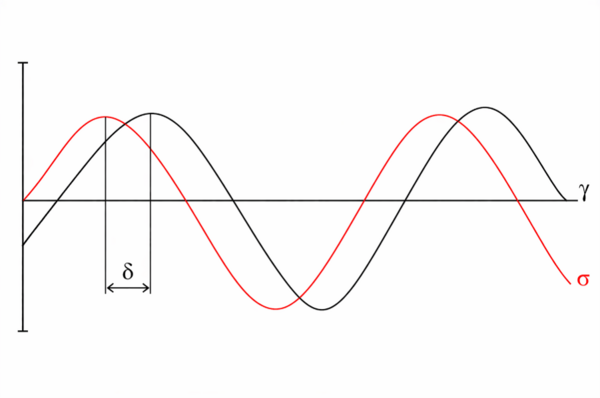
The storage modulus represents the elastic (energy-storing) component, while the loss modulus represents the viscous (energy-dissipating) component. These are defined as:
$G' = \frac{\sigma_0}{\gamma_0}\cos\delta, G'' = \frac{\sigma_0}{\gamma_0}\sin\delta$
The complex modulus is given by:
$G^* = G' + iG''$
and the complex viscosity is:
$\eta^* = \frac{G^*}{\omega}$
These quantities provide a comprehensive description of the viscoelastic behavior of polymer melts within the linear viscoelastic regime. In particular, the ratio $\tan(\delta) = \frac{G''}{G'}$ is frequently used to quantify the relative dominance of viscous versus elastic behavior.
Experimental apparatuses
The standard specifies the required experimental components needed to perform measurements, specifying the typical experimental conditions of operation:
- Forced constant amplitudes at a fixed frequency,
- Forced constant amplitudes at varying frequencies, or
- Forced variable amplitudes at a fixed frequency.
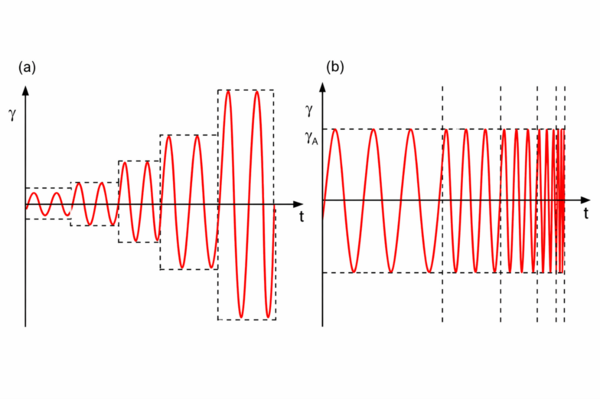
(a) Amplitude sweep: the oscillation amplitude (γ) is increased stepwise while the frequency is kept constant. (b) Frequency sweep: the oscillation frequency is increased stepwise while the amplitude is kept constant (γ_A).
Appropriate measuring geometries, such as cone-plate or parallel-plate geometries, can be used to perform these measurements. In the case of interfacial slippage (wall slip), a serrated geometry can be utilized to minimize the effect.
The instrument should be equipped with detectors that can measure dependent and independent experimental parameters with the required precision: temperature to ±1 °C, frequency to ±1 %, strain to ±1 %, and force to ±1 %. Of fundamental importance is the temperature control device, which enables precise control of the specimen temperature during heating or cooling, either in stepwise or ramped protocols, while allowing purging with air or inert gases to tailor the measurement atmosphere. Controlling the gas environment is essential for suppressing thermo-oxidative degradation, which can affect molten polymers at elevated temperatures. Such conditions are frequently applied in rheological testing, as they closely reflect industrial processing environments.
Procedure
The procedure defined in ASTM D4440 includes several critical steps to ensure reproducible measurements:
- The rheometer gap is first calibrated and adjusted to account for thermal expansion of the measuring system. This is essential for temperature sweeps, where the temperature is significantly altered.
- A representative molten polymer sample is placed between the measuring fixtures, ensuring uniform coverage and minimal air entrapment. The sample must be homogeneous and representative.
- The sample thickness is controlled (typically 1 mm to 3 mm for parallel-plate geometries) and excess material is trimmed.
- Measurements may be conducted under isothermal conditions or during controlled temperature ramps simulating processing conditions.
- Oscillatory deformation is applied within the linear viscoelastic regime, often determined through strain sweep tests.
- Frequency, strain amplitude, or temperature sweeps are then performed to obtain viscoelastic spectra.
The procedure emphasizes maintaining stable thermal conditions and avoiding degradation of the polymer during testing. As already mentioned, the ability to create an atmosphere of inert gas is crucial for testing samples prone to thermo-oxidative degradation.
Data analysis and reporting
ASTM D4440 specifies detailed reporting requirements to ensure reproducibility and comparability of results.
The following information must be documented:
- Full identification of the material (composition, source, form)
- Instrument type and configuration
- Sample geometry and dimensions
- Calibration procedures
- Test conditions, including temperature, frequency, strain amplitude, and atmosphere
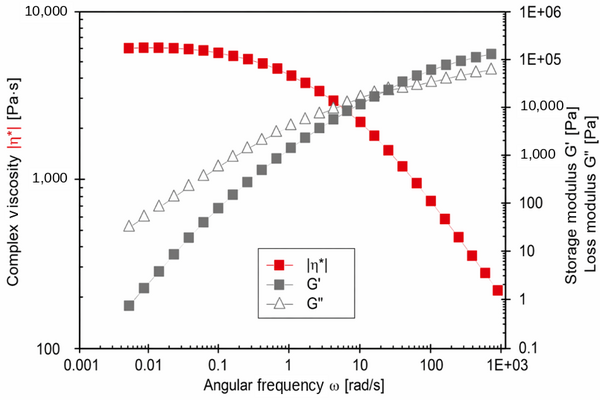
- Measured rheological data, including G′, G″, complex viscosity, and tan(δ)
- Number of specimens tested and experimental variability
- Graphical representation of rheological properties as functions of frequency, temperature, or time
Comprehensive reporting is essential because differences in experimental conditions can significantly affect measured rheological properties.
Precision and bias
The precision of ASTM D4440 has been evaluated through interlaboratory studies conducted in accordance with ASTM Practice E691.
These studies assess both repeatability (within a single laboratory) and reproducibility (between different laboratories):
- Repeatability (r): Defines the acceptable difference between two results obtained under identical conditions in the same laboratory.
- Reproducibility (R): Defines the acceptable difference between results obtained in different laboratories.
The standard reports statistical values for several materials tested under different frequencies and temperatures, demonstrating that variability depends on both material properties and test conditions.
No absolute standard reference exists for determining bias, and therefore bias cannot be quantitatively established for this method.
Measured properties and interpretation
ASTM D4440 enables the determination of several key rheological properties, including complex viscosity, dynamic viscosity components, storage modulus, loss modulus, and damping behavior. These properties are typically plotted as functions of frequency or temperature to generate viscoelastic spectra.
Such measurements are strongly linked to molecular characteristics of polymers. For example:
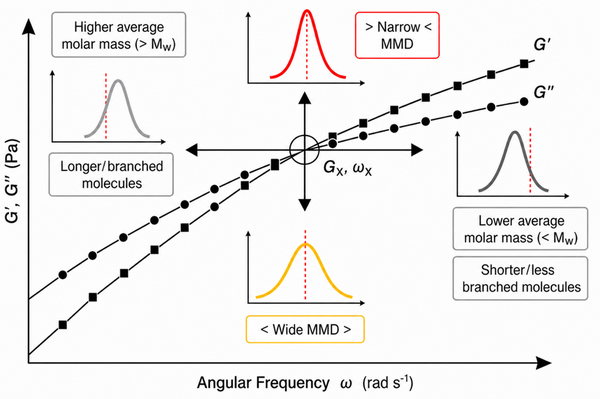
- The frequency dependence of ${G'}$ and ${G''}$ provides insight into molecular weight and molecular weight distribution.
- The crossover point where ${G'} = {G''}$ is related to relaxation timescales.
- The magnitude and slope of viscosity curves reflect chain entanglement and branching.
Additionally, the method is sensitive to formulation effects, including the presence of fillers, plasticizers, and stabilizers, which can alter melt rheology and processability.
This makes the method particularly useful for assessing the following engineering properties:
- Complex viscosity of the polymer melts as a function of the forced dynamic oscillation
- Processing viscosity, including minimum viscosity and changes in viscosity as a function of experimental parameters
- Effects of processing treatment
- Relative polymer behavioral properties, including viscosity and damping
- Effects of formulation additives
Applications
The test method described in ASTM D4440 is widely used in polymer processing and materials development.
It is particularly relevant for:
- Optimization of processing conditions such as extrusion, injection molding, and film blowing
- Quality control of raw materials and finished products
- Evaluation of thermal stability and degradation behavior
- Characterization of the viscoelastic response for engineering design
Because only small sample quantities are required, the method is also suitable for research applications and early-stage material screening.
Limitations and reproducibility
Although ASTM D4440 provides a standardized framework, the results are sensitive to experimental conditions such as temperature control, sample preparation, and geometry selection. Small deviations in these parameters can lead to discrepancies between laboratories. The standard therefore emphasizes the importance of detailed reporting of test conditions to ensure comparability of results. Repeatability and reproducibility have been evaluated through interlaboratory studies, highlighting the need for careful calibration and consistent methodology.
Conclusion
ASTM D4440 constitutes a fundamental standard for the rheological characterization of polymer melts using dynamic mechanical analysis. By providing a consistent methodology for measuring viscoelastic properties under oscillatory shear, it enables a deeper understanding of polymer structure–property relationships and processing behavior. Its integration of theoretical rheology with practical measurement techniques makes it an essential tool in both industrial and academic contexts. The continued use of ASTM D4440 supports reproducibility, standardization, and advancement in polymer science.
References
ASTM International (2008) ASTM D4440 – Standard Test Method for Plastics: Dynamic Mechanical Properties Melt Rheology. West Conshohocken, PA: ASTM International.
ASTM International (2008) ASTM D4065 – Practice for Plastics: Dynamic Mechanical Properties: Determination and Report of Procedures. West Conshohocken, PA: ASTM International.
Ferry, J.D. (1980) Viscoelastic Properties of Polymers. 3rd edn. New York: Wiley.
Macosko, C.W. (1994) Rheology: Principles, Measurements, and Applications. New York: Wiley.
ISO (1997) ISO 6721-10: Plastics — Determination of Dynamic Mechanical Properties — Part 10: Complex Shear Viscosity Using a Parallel-Plate Oscillatory Rheometer. Geneva: International Organization for Standardization.