Stick-Slip
What is stick-slip?
Stick-slip is a dynamic instability that arises from variations in the frictional forces between two surfaces, where motion alternates between sticking (zero relative velocity at a contact interface) and sudden slipping (finite relative velocity). Instead of steady sliding, this results in oscillatory motion often accompanied by vibrations and noise.
Stick-slip is observed across a wide range of physical systems, from mechanical components such as brakes and bearings to geophysical fault motion in earthquakes.[1]
Stick-slip motion arises from the interaction between elastic energy stored in a system and the velocity-dependent frictional behavior at a contact interface.[2, 3]
Two conditions are typically required:
- The system must be able to store elastic energy (e.g., through structural flexibility, springs, or contact compliance)
- The friction force must decrease with increasing sliding velocity or exhibit a significant difference between static and kinetic friction (μstat > μdyn)[2]
Under these conditions, steady sliding becomes unstable because small perturbations in motion are amplified rather than dampened.[3]
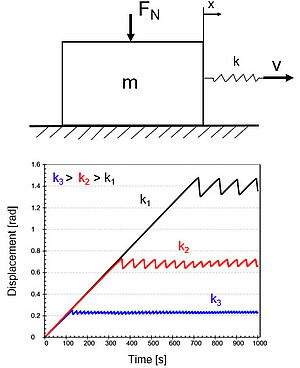
A commonly used conceptual model to illustrate this behavior is a mass m connected to a spring with spring constant k that is pulled at constant velocity v across a surface (see Figure 1). While the mass remains stuck, the spring deforms and stores elastic energy. Once the spring force exceeds the maximum static friction force, the mass suddenly slips. Because the friction force during motion is lower, the mass accelerates rapidly. As the spring relaxes and the velocity decreases, the system transitions back into the sticking phase, and the cycle repeats. This alternating process leads to oscillatory motion, often perceived as vibration or noise.
Applications and occurrences
Stick-slip phenomena occur in a wide range of engineering systems where intermittent transitions between static and kinetic friction generate oscillatory motion. Common examples include brake squeal and clutch chatter in automotive systems, as well as rolling and sliding bearings, where frictional instabilities can lead to noise, wear, and reduced performance. In rail–wheel contacts, stick-slip contributes to characteristic high-pitched sounds and influences traction behavior. Similarly, in windshield wiper systems it manifests as juddering motion across the glass. In many of these applications, the resulting vibration amplitudes and frequencies are linked to the structure’s natural frequencies and vibration modes.
Despite often being undesirable, stick-slip can also be harnessed beneficially. A well-known example is found in bowed string instruments, such as violins and cellos, where the periodic sticking and slipping between the bow and string generate sustained vibrations that produce musical tones. In this context, controlled stick-slip motion is essential for sound production, demonstrating that the same physical mechanism responsible for noise and wear in mechanical systems can, under the right conditions, be transformed into a useful and even artistic effect.
Prevention and mitigation of stick-slip
Stick-slip can be reduced or prevented by modifying either the system’s dynamic behavior or the friction at the contact interface. One common approach is to increase damping, meaning the system is better able to dissipate energy. If the damping is sufficiently high, it counteracts the destabilizing effect of friction and causes oscillations to decay rather than grow. Instability typically occurs when this balance is reversed, so increasing damping helps restore stable motion.[1, 3]
Another effective strategy is to increase the system stiffness. A stiffer system stores less elastic energy during the “stick” phase and releases less energy during slipping, which reduces the tendency for oscillations to develop. At the same time, increasing stiffness can shift the system’s natural frequencies, potentially moving it away from conditions where stick-slip is easily excited.
Finally, stick-slip can be mitigated by modifying the frictional properties at the interface. This includes reducing the difference between static and kinetic friction (e.g., through surface treatments or lubrication). The use of boundary lubricants or additives can smooth the transition between sticking and slipping.[2] In addition, operating conditions can be adjusted so that friction increases with sliding velocity, which promotes stable, continuous motion instead of intermittent stick-slip behavior.
Conclusion
Stick-slip demonstrates how friction, energy storage, and system dynamics interact to produce instability across many physical systems. Its occurrence in both the technical and the natural context highlights its fundamental importance. Understanding and controlling stick-slip enables improved system performance and creates possibilities for its deliberate use in functional applications.
References
[1] Bhushan, B. (2013) Introduction to Tribology. 2nd edn. Hoboken, NJ: John Wiley & Sons.
[2] Czichos, H. and Habig, K.-H. (2020) Tribologie-Handbuch: Tribometrie, Tribomaterialien, Tribotechnik. 5th edn. Wiesbaden: Springer Vieweg.
[3] Popov, V.L. (2016) Kontaktmechanik und Reibung: Von der Nanotribologie bis zur Erdbebendynamik. 3rd edn. Berlin: Springer.